Do I Need a Swing Gate on My Fixed Ladder?


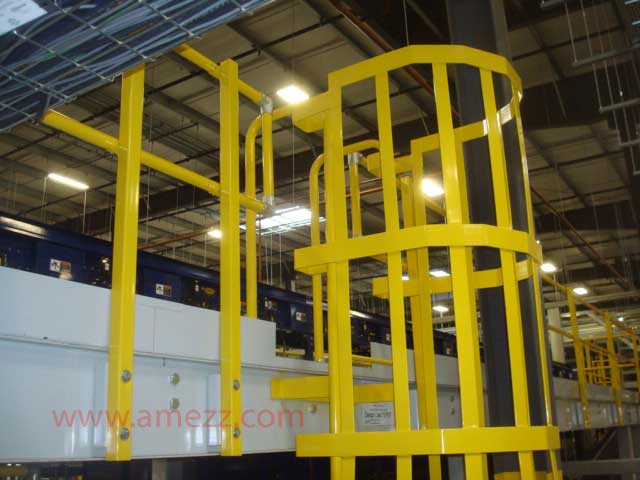
Walk-thru fixed ladder with cage

Walk-thru fixed ladder with safety cage

Do you need a ladder gate at your ladder opening in your railing? According to OSHA 1910.28(b)(3)(iv)“Each employee is protected from falling into a ladderway floor hole or ladderway platform hole by a guardrail system and toeboards erected on all exposed sides, except at the entrance to the hole, where a self-closing gate or an offset must be used.”

This means that every ladder opening needs to be either (a) Offset so that a person cannot walk (or fall) directly into the opening or (b) Protected by a ladder safety gate. It is an easy either/or. The most common ladder installation locations are not offset and as such require safety gates. Below you will see some photos of ladders and top view sketches clarifying why each of their orientations either do or do not require a gate. Note: ladder chains do not meet OSHA standards.

Another seemingly redundant standard from OSHA further increases the areas requiring gates is 1910.29(b)(13) and 1910.29(b)(13)(i): When guardrail systems are used around holes that serve as points of access (such as ladderways), the guardrail system opening: (1910.29(b)(13)(i) has a self closing gate that slides or swings away from the hole, and is equipped with a top rail and midrail or equivalent intermediate member(…). 

This standard opens up gate requirements to manhole covers, roof hatches and other similar systems that would remain open while accessed.

Now that we know what the code requirement is, it is time to review a few common ladder mounting orientations to discuss where they fall under the code.

Fixed ladder mounted to side of platform

Fixed ladder mounted to side of platform

The above fixed ladder is mounted onto the side of the platform. Work is performed further down the platform but it is possible to fall directly down the ladder opening. This location is not offset and as such would require a swing gate. See the below top view sketch for clarification.

Top view sketch of side mounted fixed ladderway opening

Top view sketch of side mounted fixed ladderway opening

You can walk directly to the ladder opening from where work is/can be expected to be performed and as such, a safety gate is required at the ladder opening.

Fixed ladder with offset landing platform

Fixed ladder with offset landing platform

The above ladder accesses a platform and then turns to access the main walkway. This ladder is offset and would not require a swing gate at the opening.
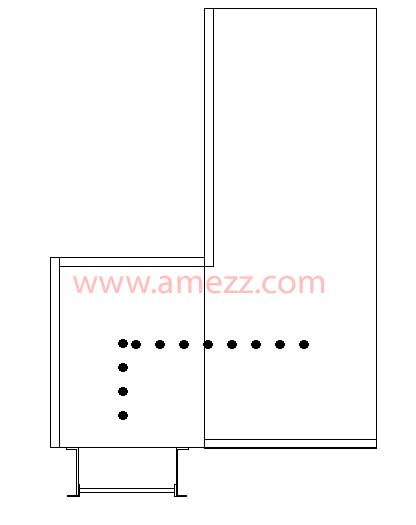
Top view sketch of offset mounted fixed ladderway opening

Top view sketch of offset mounted fixed ladderway opening

As you can see above, if someone fell while at the main walkway they would fall onto the ladder landing surface, they would not fall down the ladder opening. If the ladder was rotated to the left side of the landing it would require a safety gate because then the ladder opening would no longer be offset.
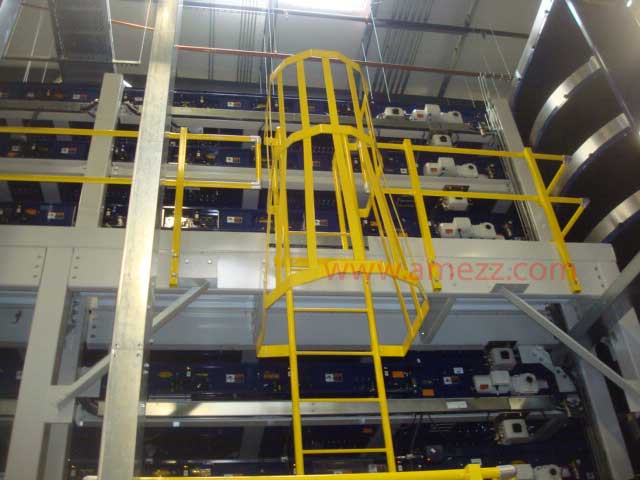
Ladderway opening on side of catwalk

Ladderway opening on side of catwalk

Above is a very common ladder mount position. This one can be tricky until you lay it out from the top view. From first glance it looks like because the ladder is off to the side that it would be offset from the normal flow of traffic, but if you fell at that point of the catwalk there would be no guarding to protect you. A swing gate is a requirement at this location.
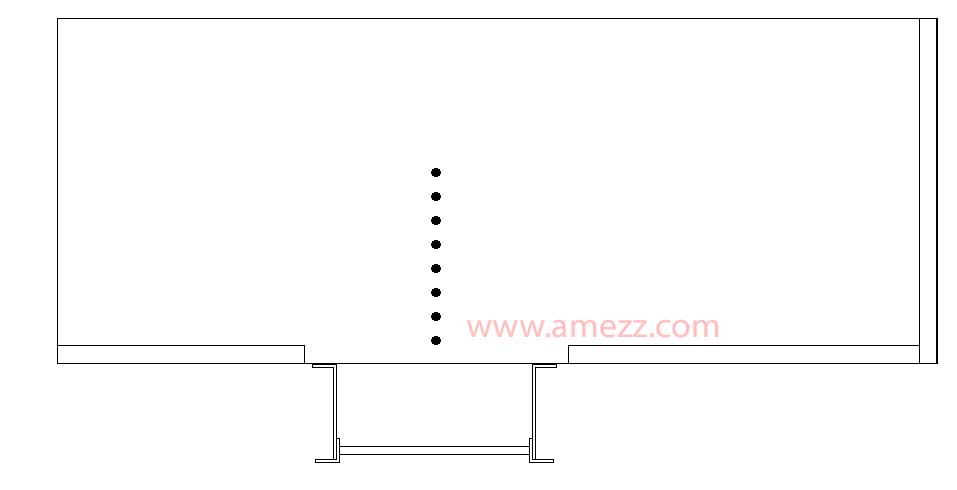
Top view sketch of catwalk side mounted fixed ladderway opening

Top view sketch of catwalk side mounted fixed ladderway opening

As you can see from the above sketch, there is a single direction of travel to the ladder from the catwalk. This is not offset. It would be a single direction fall into the ladder opening and as such, a ladder safety gate is required to protect your employees when a ladder is installed in the above orientation.

Most areas are not offset. A good rule of thumb is that if you can fall into the ladder opening with a single direction fall, then you are not offset. The only example above that didn’t need a gate was the second ladder location. With that orientation, you would fall onto the ladder landing and then hit the rear railing, not fall through the ladder opening.

Finishes of modular building wall panels

When starting out on a project, it’s important to pick the right material. Painted mild steel rusts when used outdoors. Wood products swell when soaked. Stainless steel is expensive. You need to compare the properties of the material against the environment in which it will be utilized.

Modular wall systems are a versatile piece of equipment used in a number of different environments and applications. Because of this, we offer a number of different types of finishes on the panels so that we can meet the different requirements of the project.

 Modular building panels with a vinyl finish

6 mil. vinyl, Class A fire rated,  stipple textured vinyl.   Bone and white are standard.

Bone vinyl over gypsum A-wall building panel

The vast majority of the modular buildings we provide feature a vinyl finish to the panels. It serves as our best, and most cost effective, general all-purpose finish, offering you a clean finish to the panel so that you don’t need to paint the walls in the field. Being covered in vinyl also allows you to clean them with a damp sponge if the walls get dirty. One common application where we would use vinyl clad panels would be in an office space.

Modular building panels with a painted steel finish

Embossed, 24 gauge,  galvanized, painted steel.   Almond and white are standard. Smooth also available.

Almond painted steel over gypsum A-wall modular building panel

Another common option that we offer is to finish the panels with painted steel sheets, which can be applied to the inside of the panel, the outside of the panel, or both. Most commonly this is used in equipment enclosures where we are concerned that something might pierce the walls. The steel sheet acts as a layer of armor helping to prevent shrapnel from puncturing the system. The steel sheets also offer an additional benefit important in many equipment enclosures. Our typical wall panels consisting of two sheets of ½” gypsum board separated by polystyrene studs generally offer an STC of 32. The additional mass of the steel helps minimize the ability of sound to be transmitted through the walls. For each side of the wall that is clad in steel the STC rating increases roughly by one.

Fiberglass reinforced plastic modular building panel finish

Pebble textured, Class  C fire rated, Fiberglass Reinforced Plastic. Khaki and white are standard.   Smooth and Class A also available.

Khaki FRP clad gypsum modular wall panel

The third most common finish that we offer is fiberglass reinforced plastic (or FRP). FRP is our most durable modular wall panel finish. It holds up exceptionally well to various scrapes and abrasions, and the FRP is a more water resistant finish as well. One of the most common applications where we’ll use an FRP wall panel finish would be for bathroom walls.

Stay safe everyone!

We received a sobering message from a customer looking at our caged fixed ladders today:

 “My dad fell off of the roof to his death in June while trying to come down the ladder he had rested on the side of the building.  I believe his foot got caught in the rope.  If he had had one of these ladders this would not have happened.”

Stay safe out there everyone. I know that the above was just a random accident but if there is the chance that you can prevent those, especially after hearing about what can happen, why wouldn’t you?  Taking precautions and doing things the safe and right way may take a little longer or cost a little more, but going home to our loved ones at the end of the day is worth any price.

Our sincere condolences are with this customer and their family and hopefully sharing this story will cause someone else to take a moment to look around and make sure they are taking all necessary safety precautions. If you are unsure if you are doing something right, ask someone.

With a little help we can all make it home safe tonight.

Replacement Stair Rails

We recently were called out to a site with a corrosive environment that was in need of replacement stair rails as all of the original handrails were rusting and in disrepair. The paint was almost all chipped up, and some areas of the handrails were so corroded you had to choose between risking a fall by not grabbing the stair handrails, and grabbing the handrails but risking the need for a tetanus shot.

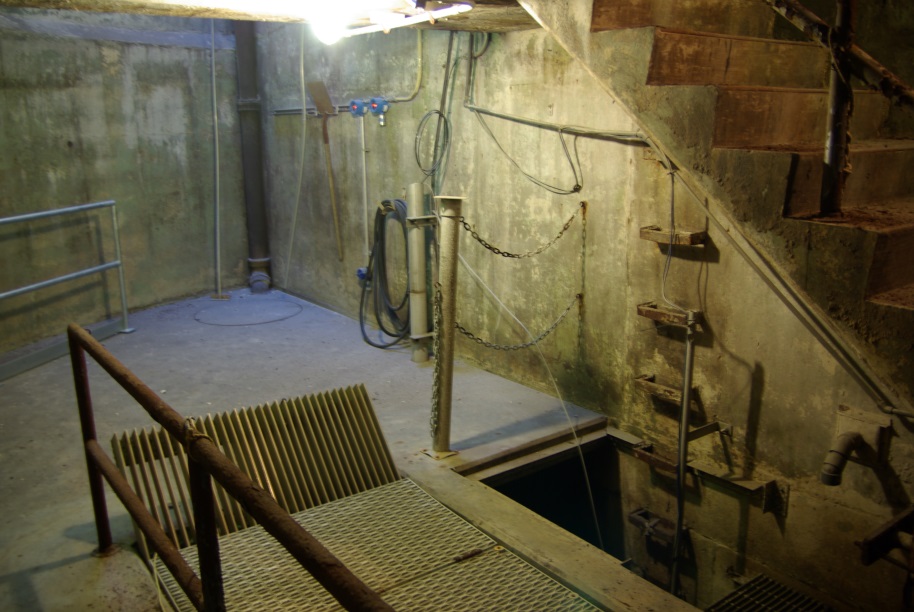
Existing railings corroded from damp environment

Existing railings corroded from damp environment

The above picture shows the lowest section with a bollard and chain assembly “protecting” the pit ladder that is bent, corroded and weakened at the base. It also doesn’t meet OSHA standards for rail heights or strength at top rail. You can also see the rusted handrail and stair rail. Anytime you have a damp environment it’s best to use a material besides carbon steel – Galvanized steel, aluminum or stainless steel all perform much better over time. Remember that corrosion doesn’t just make the metals look bad, but it also weakens them, substantially lessening their lifetime usability. Sure, the other metal options cost more than plain carbon steel, but when you have to replace the material before its time you have to pay for demo of the inferior material, fabrication of the new material, installation of the new material and have the lost time from the job being out of service during that process.


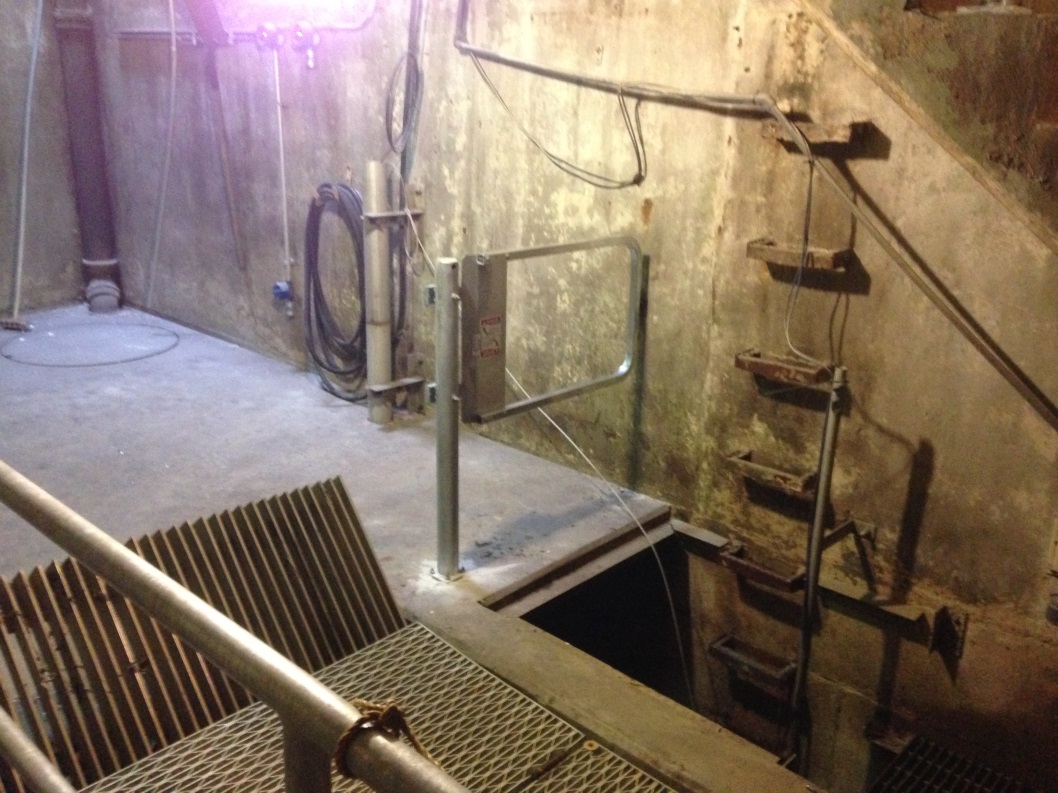
New hot dipped galvanized replacement stair rails and safety gate

New replacement hot dipped galvanized railings and safety gate

Here is the same view after we finished. We removed the bollard and replaced it with one with a more sturdy post and baseplate. The chains were removed and replaced with our MLG Ladder Safety Gate with a hot dipped galvanized finish. The new set-up is going to stand up to the moist, caustic environment much better and easily meets OSHA standards for guarding at a ladderway opening.

29 CFR 1910.23 Guarding of floor and wall openings and holes. “(a)(2) Every ladderway floor opening or platform shall be guarded by a standard railing with standard toe board on all exposed sides (except at entrance to opening), with passage through the railing either provided with a swing gate or so offset that a person cannot walk directly into the opening.”

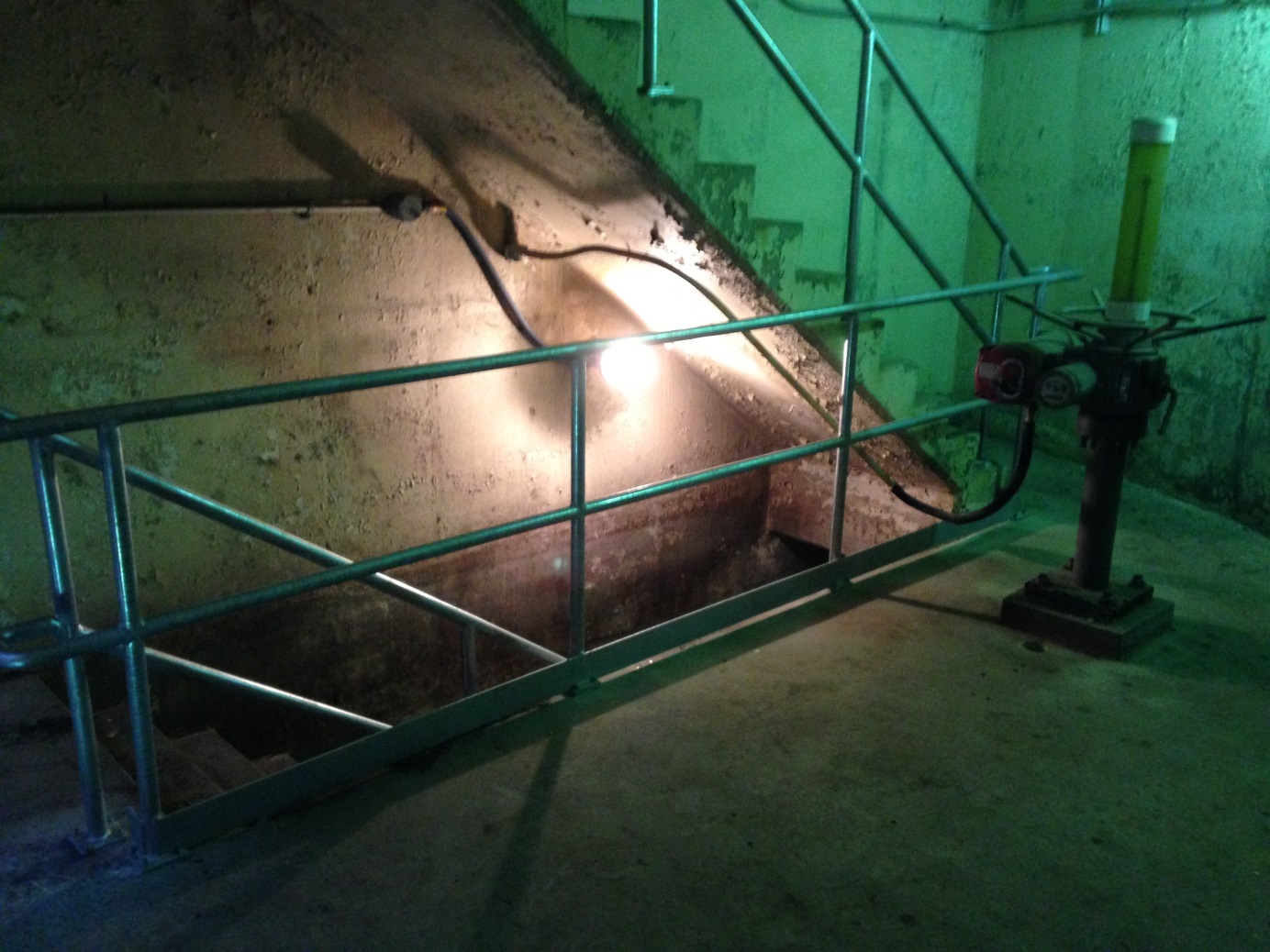
New rails with OSHA required toe guard to prevent items from falling over the edge

New rails with OSHA required toe guard to prevent items from falling over the edge

All of the new handrails were done to OSHA standards with a 4” toe kick at the bottom, a 21” mid rail and a 42” top rail. Along the stairs, the stair rails were 34” high from the edge of the nosing. There was no wall mounted rail as the stair width is less than 44” wide and there is only one open side.

29 CFR 1910.23 (d) Stairway railings and guards. “(1)(ii) On stairways less than 44 inches wide having one side open, at least one stair railing on open side.”


Smooth, continuous handrail to maintain contact with rail throughout the climb

Smooth, continuous handrail to maintain contact with rail throughout the climb

The replacement stair rails are designed for a seamless transition between flights, allowing someone to slide their hand from the top rail to the bottom of the stairs without letting go of the rail. This gives a nice, clean look and also allows for safer access and increased strength of rails. Added strength also comes from the baseplate design with a four bolt pattern to maximize rail strength and minimize movement regardless of where pressure is applied front, back, top etc.

There were some unique challenges to this project with the winding rails, but with proper site dimensions and knowing the details about the installation environment, it was quite easy to supply this customer with replacement rails that fit and will last them a lot longer than their previous set.


Using a Pallet Gate to Protect a Second Story Doorway Opening

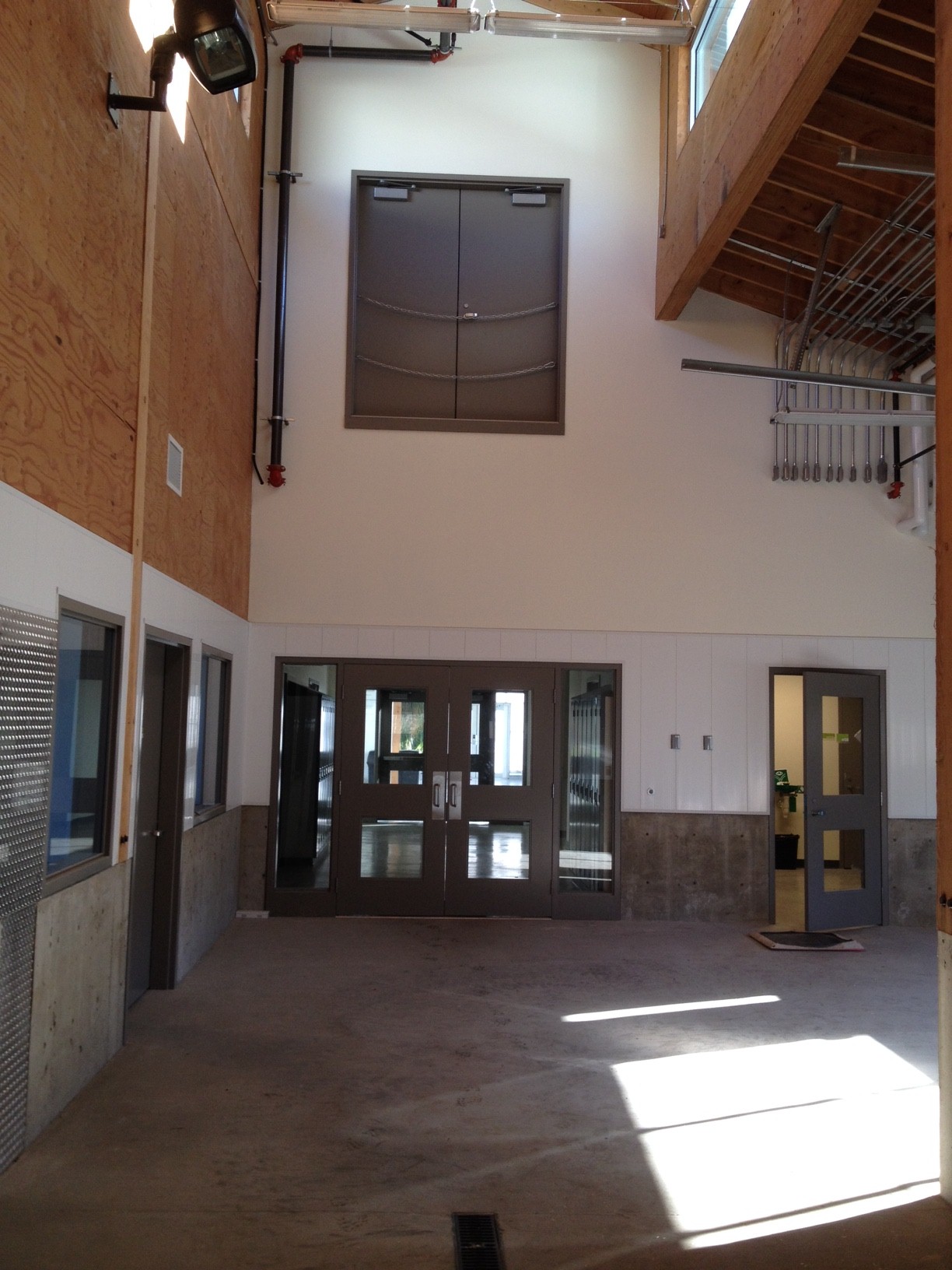
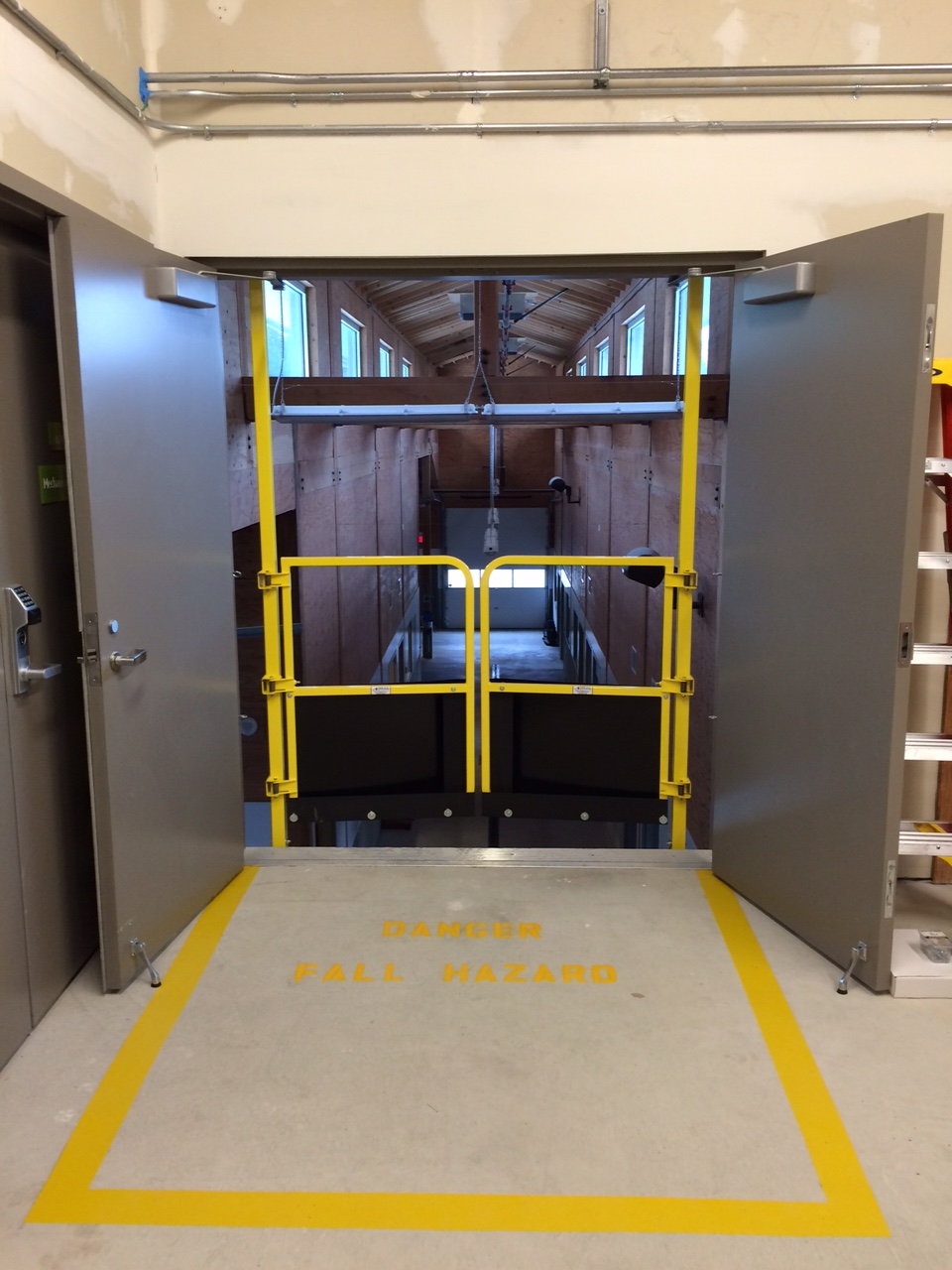
Second story double doorway used for pallet access from below

Second story doorway opening with snap chains

We are often contacted by customers looking for a pallet gate to use in an atypical application.  Most commonly they have a second story that has been closed off with walls and a set of double doors through which they load pallets from below.  We recently received some photos back from a happy customer out in British Columbia for whom we provided a solution for just such a case.

The customer wanted something more substantial than the snap chains across the door frame to guard the opening when the doors were open.  In order to assist them with this, we provided them with a customized self closing pallet gate.

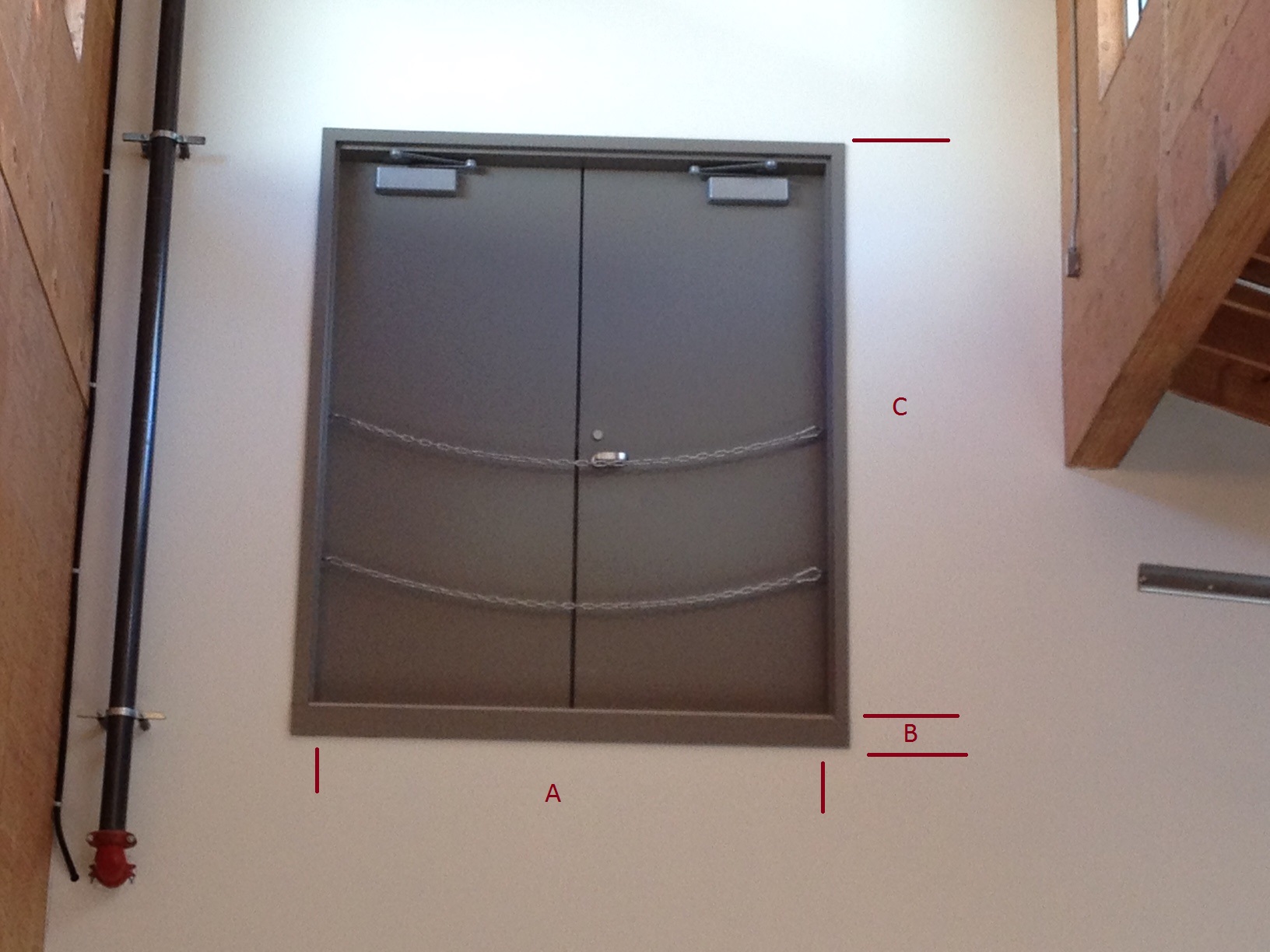
A: The clear opening width of the doorway.  B: From the second story floor to the bottom of the door frame.  C: From the second story floor to the top of the door frame

The required dimensions to properly fit a pallet gate on a door framed opening

The gates on the self closing pallet gate need to freely swing inward and clear the existing doors.  The clear opening with on their doorway was 6’.  In order to save the customer some money we used our standard hoops for a 5’ clear opening width gate.  The overall width is approximately 5’6”, leaving about a 3” gap on either side when centered on their doorway.  If necessary, we could have gone with a custom width, but remember, the largest self closing pallet gate we can provide has a 6’ clear opening (approximately 6’6” overall) width.

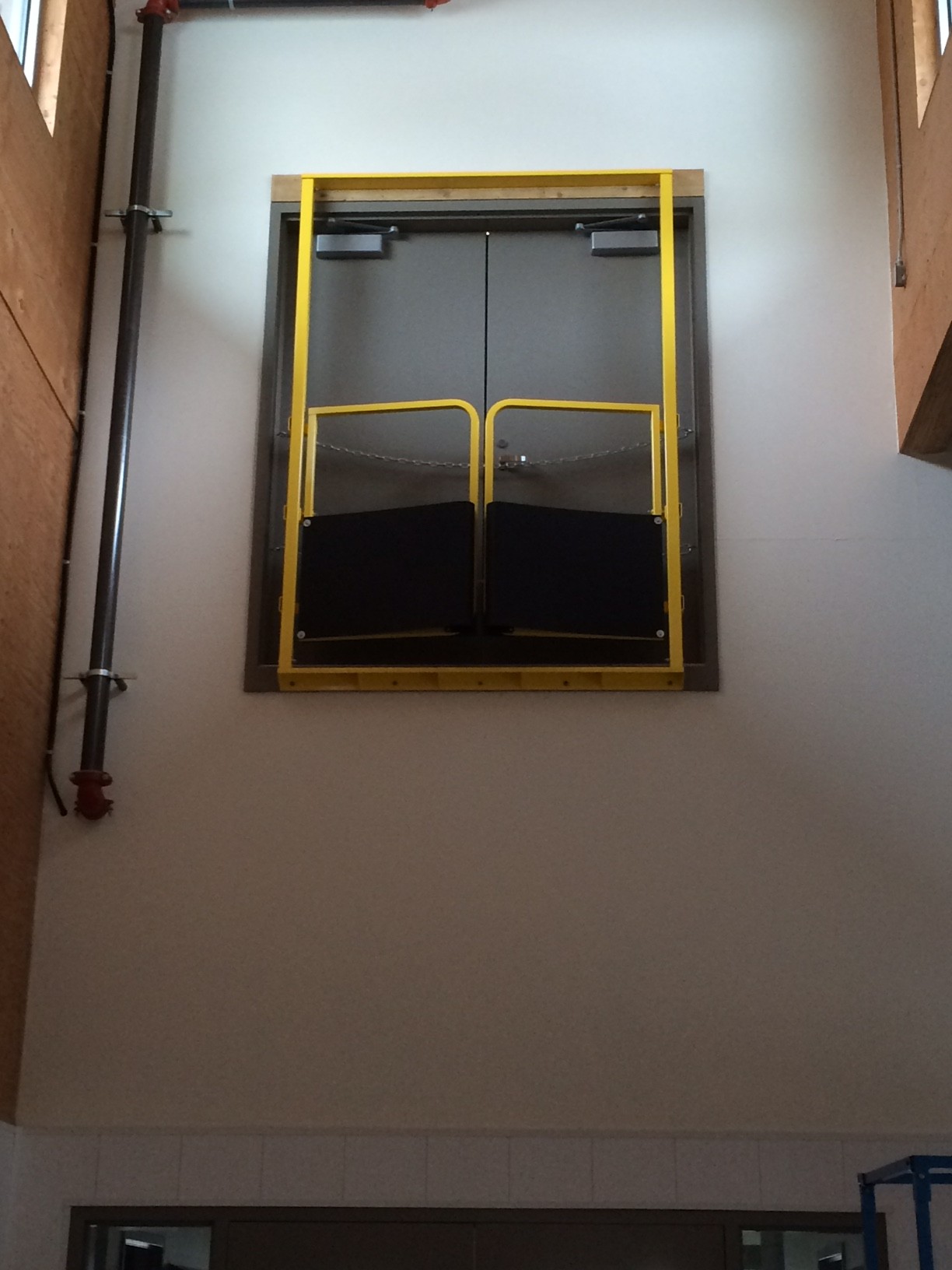
Outside view from the bottom of pallet gate mounted around a door frame

Wall mounted self closing pallet gate being used to guard a second story doorway.

As the gate wasn’t being mounted in the usual fashion to industrial handrail to the sides, we provided special angle brackets and longer columns to fix the gate to the wall above and below the door frame.  If the floor extended beyond the doorway, we could have gone with the angle bracket above and the typical floor mount brackets to mount it to the deck below.

Pallet gate guarding the open doorway

Inside view of the second story doorway opening being protected by the self closing pallet gate

With this gate in place, when the customer opens their doors, the opening is still protected with industrial use handrail.  Their fork truck driver just needs to push the pallet against the bumpered gates which will open as they load the pallet into position on the second story.  When the customer pulls the pallet away from the landing area, the spring loaded hinges will automatically close the gate, once again protecting the door opening until the customer closes their doors.

Mezzanine Deck Surfaces: Roof Deck with Steel Plate

Let’s continue on with our discussion on the advantages and disadvantages of the various types of deck surfaces we offer on our mezzanines.  First we talked about corrugated roof deck with resindek.  We mentioned that it was an extremely versatile and cost effective solid deck type, but that as a wood composite material it doesn’t perform well in environments where it is prone to getting wet.  Next we talked about open bar grating:  an open steel deck surface that excels in outdoor/wash down environments as it allows water, snow, and debris to fall through.  While texture in the bar grating provides a very grippy surface, it makes it very difficult to move pallets across and there are times when you don’t want materials to fall through the deck.  Today we’re going to talk about a mezzanine deck surface that combines features of both of these — corrugated roof deck with steel plate.

Like roof deck and resindek, roof deck with steel plate is a solid deck surface composed of two layers.  The strength of the deck comes from the corrugated roof deck.  The steel plate is there to provide a flat surface to walk across.  Typically we use a smooth plate which allows for easy transport of pallets, carts and other rolling materials.  Every once in a while though, where this is not the plan, we’ll go with a steel plate that has a raised texture to it, providing a better grip.  It’s a very strong and durable deck surface, and being a steel deck, it holds up in potentially wet environments.  In particularly wet environments you’ll want to seam weld the deck and set up a drainage system so the water doesn’t get trapped in the corrugation.

The biggest disadvantage of roof deck with steel plate is its cost, which is comparable to open bar grating.  Many of the applications that call for a closed deck mezzanine would be equitably serviced by resindek as it would by steel plate.  The resindek would have the advantage, though, as it is significantly less expensive.  Unless it’s in a potentially wet environment or being installed in a location where no wood is allowed, you might as well save your money and go with the resindek.

Bi-directional gates are not SAFETY gates

Safety gates can be confusing. Don’t let them be.

Safety gates can be confusing. Don’t let them be.

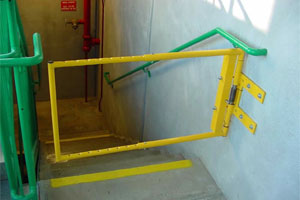
We often get calls from customers looking for bi-directional safety gates, i.e. gates that do not have a stop and swing both in and out. Often these customers are looking for gates for staircases to hang signage on in order to “restrict access” beyond certain floors in staircases. The problem is that these gates do not meet OSHA standards for fall protection. OSHA’s guard rail standard requires a top and mid rail and requires the gate to hold back a minimum of 200 lbs. of pressure at the top rail. By definition, bi-directional gates do not meet that requirement, especially when used at the top of stairs. The best option for these customers is to use a self-closing and self-stopping gate, similar to our AG series of gate.

Stair safety gate mounted with the orientation requiring user to pull the gate towards them to walk downstairs. Coming upstairs, the user would simply push through the gate.

Stair safety gate mounted with the orientation requiring user to pull the gate towards them to walk downstairs. Coming upstairs, the user would simply push through the gate.

When used at the top of stairs, these gates can be positioned to require anyone going down to a restricted area to pull the gate towards them and descend the steps. They can also be positioned at the bottom of the steps requiring anyone going up the steps to pull the gate toward them to ascend the steps.

What you cannot do, and what is not safe by any means, is to do the opposite. If you install a bi-directional gate at the top of a staircase and someone falls into it, odds are they are going to have a very bad injury.

Bi-directional gates are not fall protection. They can actually give a false sense of safety creating more accidents.

Bi-directional gates are not fall protection. They can actually give a false sense of safety creating more accidents.

So take the extra second and install the proper gate for your location. Being safe is a LOT cheaper than cutting corners.

Mezzanine Deck Types: Open Bar Grating

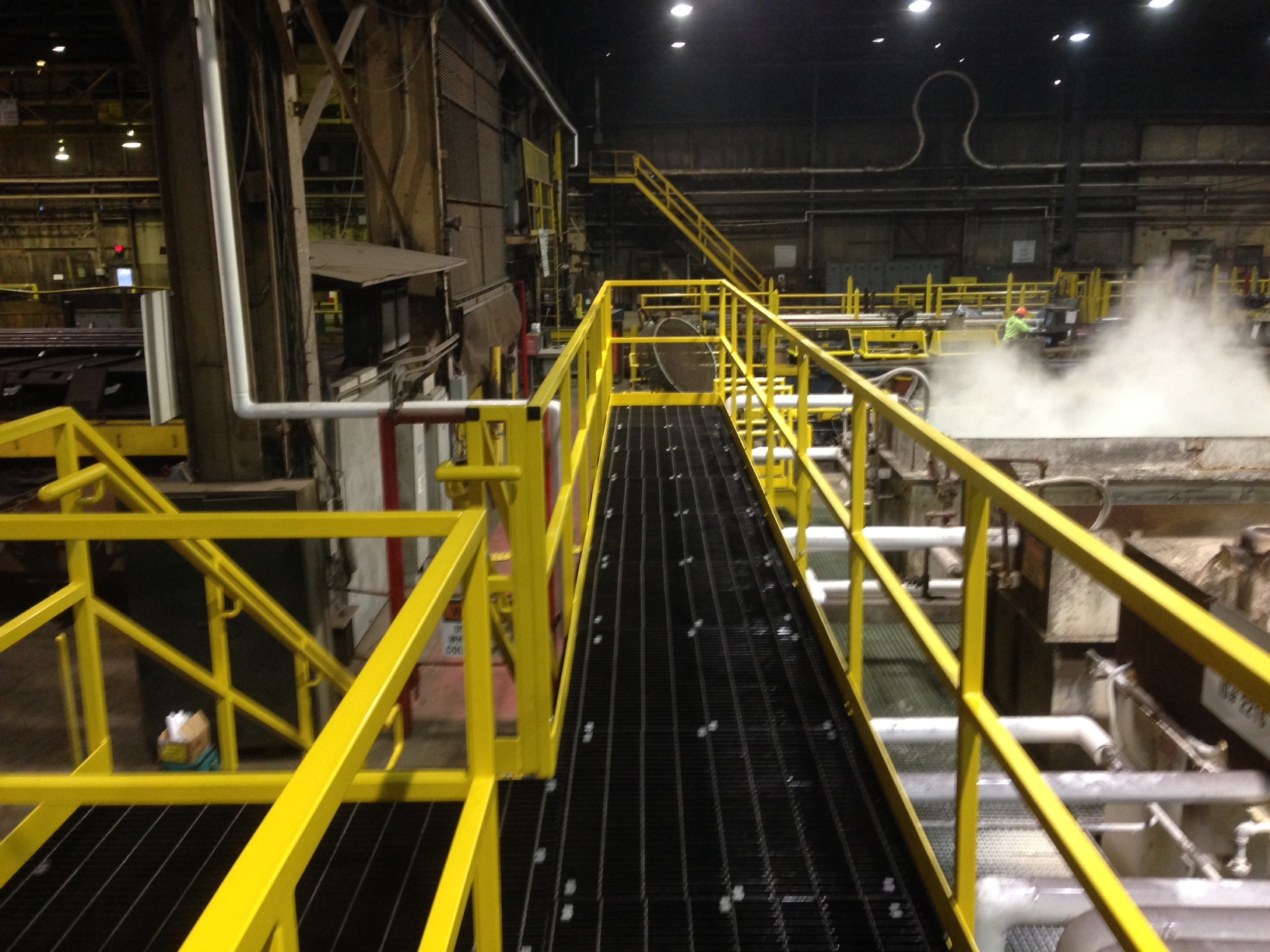
Painted 19W4 open bar grating on an observation catwalk

Open bar grating deck surface on an observation platform.


Let’s continue our exploration into the different types of decking used on our mezzanines.  Last time we talked about corrugated roof deck with resindek.  We mentioned that as a wood composite material it can swell if soaked, so it is not the ideal deck type for wet environments.  Today we’re going to talk about one deck type that excels in wet environments:  open bar grating.

The typical grating that we use is a 19W4 bar grating.   It’s made by taking steel bearing bars placed 1-3/16” on center and joining them together by welding wire rod cross beams perpendicular to the bearing bars every 4” creating an open grid.  The grating typically has either a painted or galvanized finish depending on the application.

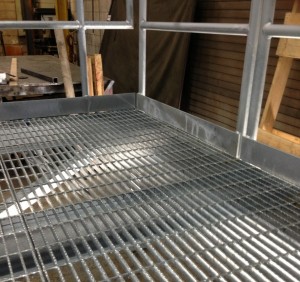
Galvanized serrated 19W4 open bar grating on a mezzanine deck

Serrated and galvanized open bar grating on a landing bound for the outdoors.


Galvanized and serrated open bar grating is an ideal deck solution for outdoor applications.Open bar grating has many advantages as a decking material.  It is very strong and durable, and the grated surface provides excellent traction.  For particularly slick locations, such as oil factories or outdoors in icy environments, we offer a serrated version for even better grip.  As an open decking surface it easily allows water, air, and light to pass through the system.  This is why it is a particularly popular decking material for outdoor applications.

There is one common misconception about the open bar grating that I would like to note though.  We are often asked to put open bar grating in sprinkled environments, with the customer thinking that they will not need to add sprinkler lines below the platform.  Unfortunately this is not the case.  The decking and framing of the mezzanine system occlude the area below enough (even before factoring in the materials on top of the platform) that your fire inspector will still require you to sprinkle below the deck if it is sprinkled above.

Oddly enough, open bar grating’s strengths are also its weaknesses.  As a fabricated steel material, it is significantly more expensive than the resindek.  The grated surface makes it extremely difficult to roll pallets and such around on top without adding something like a layer of plywood in order to provide it with a smooth surface to roll across.  And as an open, porous material it allows things to flow through it, such as fingers, heels, dropped hardware (i.e. nuts, bolts, screws), or spilled material.

Commercial and residential roof hatches for pitched roofs

economy series roof hatch mounted on a pitched roof

Standard roof hatch on a pitched roof

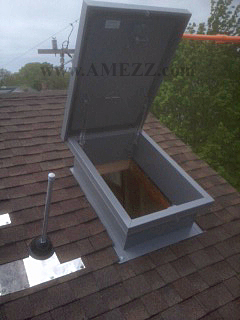
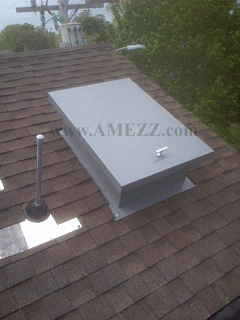
We received this set of photos from a customer who used our “off the shelf” Economy Series Galvanized Roof hatch on a pitched shingle roof like you would find in many commercial and residential locations. The standard roof hatch comes with cap flashing and 1” thick rigid fiber board insulation along the curb of the hatch. For this installation, the customer removed the curb insulation from the hatch and bolted the hatch down to the roof. They wanted the most economical roof hatch solution that had a low profile to match the roof slope. Ordinarily we would suggest using a pitch corrected roof hatch on slopes greater than 3/12, but the infrequent use and need for a low profile roof hatch was more important to the customer than the advantages of the pitch corrected roof hatch. Below are some pros and cons of each setup to help you decide which solution is best for your situation.

Open roof hatch showing clearances on a sloped roof

Open roof hatch showing clearances on a sloped roof

Economy series hatch installed on a shingled, sloped roof

Economy series hatch installed on a shingled, sloped roof


Standard roof hatch on a pitched roof pros:

  • Low cost
  • Standard sizes most likely in stock for immediate shipment
  • Low profile on roof

Standard roof hatch on a pitched roof cons:

  • Cannot use roof hatch railing (roof hatch railing may be required by OSHA depending on your site conditions)
  • Increased strain on hardware – installation on pitches 4/12 and greater are not covered by warranty
  • Decreased opening area due to roof hatch angle (see above photos)
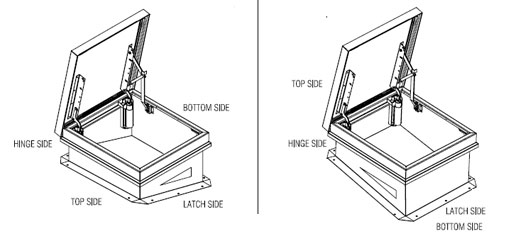
Sample pitch correction options for roof hatch curbs mounting on sloped roofs

Sample pitch correction options for roof hatch curbs mounting on sloped roofs

Pitch corrected hatch on a pitched roof pros:

  • Larger opening for exiting on a pitched roof
  • Less strain on the hardware
  • Roof hatch railing can be installed on pitch corrected curbs
  • Needed for warranty coverage on pitches of 4/12 and greater
  • Required for larger roof hatches on pitched roofs

Pitch corrected roof hatch on a pitched roof cons:

  • Slightly increased cost (made to order)
  • Increased lead time (made to order)
  • Taller curb on low end of roof may be more visible from ground level

Using the pitch corrected hatch for your pitched roofs over 3/12 gives you the standard manufacturer’s  warranty and can give you a larger opening to go through, but ultimately it comes down to your specific needs and what is most important for you. If you have any questions, please contact us.

Stairway Visibility Through Contrasting Colored Step Nosing

By Jared @ Floormatstore.com

The other day, a friend called me up to discuss safety codes in regards to stairs. He was moving his son out of his apartment and carrying the sofa down the stairs. The rubber stair treads were in terrible shape, cracked, worn through and just in general need of replacement, which of course presents a safety issue on its own. The larger issue he had called about though, was stairway visibility. The stair treads had grit stripping in the nosing – which is a sandpaper-like tape, used for extra traction and visual awareness – on all but a few of the steps, one of which was the last step before a landing. Walking down the stairs backwards, carrying one end of the sofa, the bottom step – missing the strip – blended in with the landing below it, giving the false impression that he had reached the landing. As you could guess, stepping back, thinking that he had reached the landing, caused a bit of a stumble. I’m sure we have all experienced that moment of terror, where your heart jumps up an inch, your stomach is sucked up into your chest and your breath stops for a split second that feels like minutes. Luckily for him, he caught himself before fully falling down and walked away without injury. His story made for a great discussion on the topic of contrasting color for visual awareness.

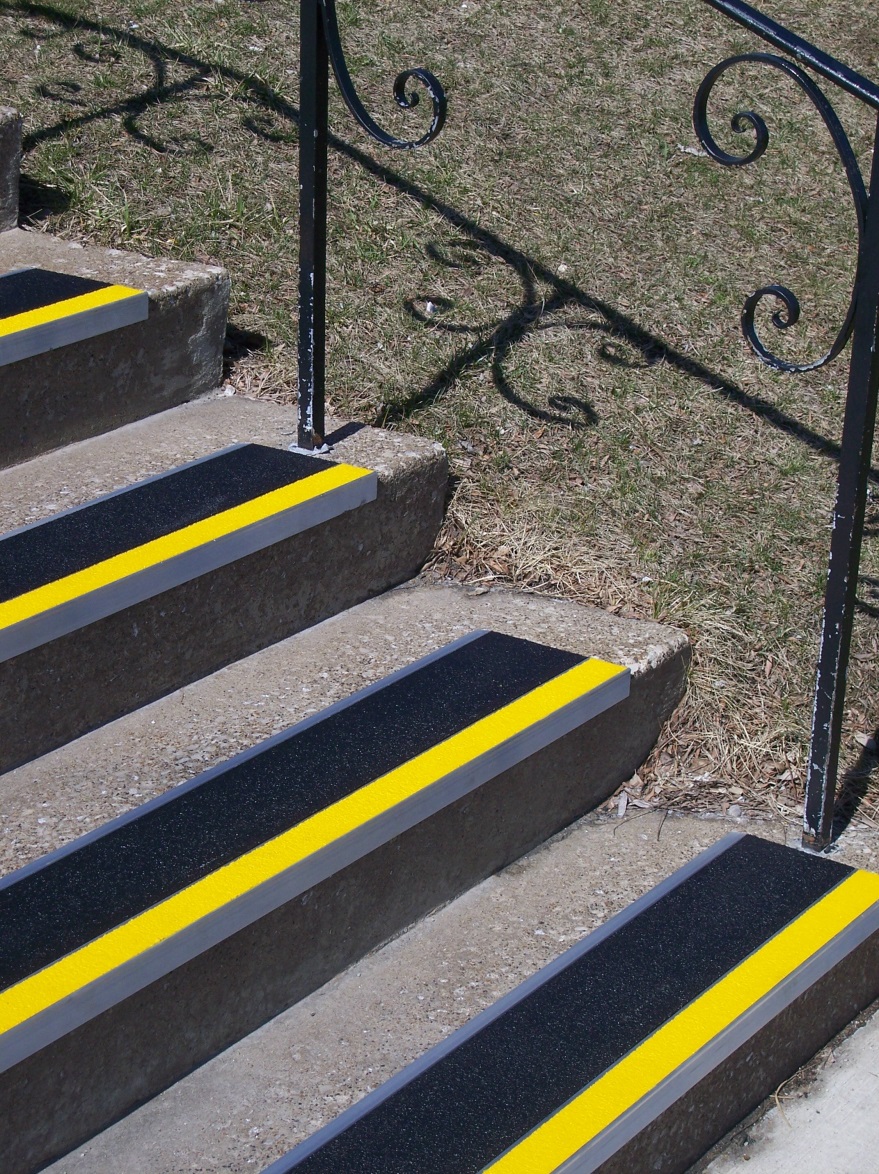
One of the highest causes for accidents on stairways is poor visibility of both risers and treads. Poor visibility can cause people to misread the edge of a step, causing them to fall. One of the best and most cost effective ways to increase visibility is by providing a visual contrast on the leading edge of treads. According to the U.S. Access Board Research, safety yellow is the most ‘visually detectible’ color.

FloorMat-Store.com GSA9 Aluminum Stair Treads displaying a black tread with contrasting safety yellow leading edge

FloorMat-Store.com GSA9 Aluminum Stair Treads displaying a black tread with contrasting safety yellow leading edge

Whether or not the contrasting stripes are a requirement is a debated topic across the country. Because stairs are not part of an accessible route, ‘ANSI A117.1 Section 504 Stairways’ does not technically apply to the IBC. The misconception comes from the commentary for subsection 1102.1 Design. Visual contrast is not referenced into the IBC, so it only applies if the authority having jurisdiction has specifically incorporated the requirement into their set of codes. For example, all of California does require them. Also, according to ADASAD Advisory 504.4 Tread Surface, the contrasting color is not required, but strongly suggested. If you are unsure of the requirements in your area, check with your local building inspector.