How to properly paint galvanized metal staircases and railings

What is hot dipped galvanized metal and why do people use it?

Before we get into how to paint over galvanized metal, let’s give a really quick background into what hot dipped galvanizing is and why people would do it.
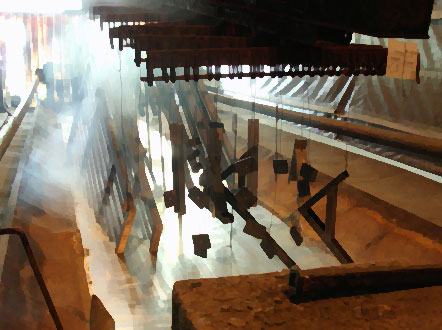
Stair parts being lowered into a bath of molten zinc

Stair parts being lowered into a bath of molten zinc

Hot dipped galvanizing is a process that involves dipping steel into a bath of molten zinc. This process creates a coating that is metallurgically bonded to the steel, in essence becoming the outer layer and part of the steel itself.
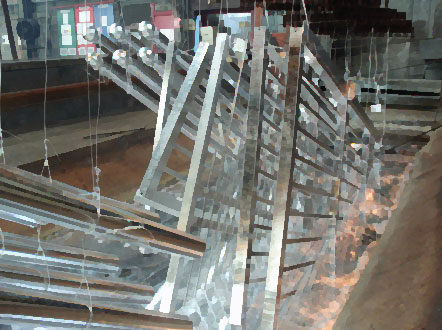
Stair components coming out of the zinc bath

Stair components coming out of the zinc bath

The galvanized coating adheres to the steel at around 3600 psi, where other coatings, like zinc rich painting and zinc plating, adhere to the steel at a rate of 300-600 psi at best. The hot dipped coating has a hardness of between 170-250 DPH (Diamond Pyramid Hardness) as compared to the soft non-abrasion resistant coating of zinc rich paint or a 75 DPH hardness of zinc plating.  This is important as it shows why hot dipped galvanizing is such a popular means of corrosion resistance as opposed to other coating options out there.

How do I paint over hot dipped galvanized steel?

If you are looking for a finish other than the shiny or dull galvanization finishes (there are cosmetic differences between each in luster, but no corrosion difference between the two), you would need to do a duplex, or two part, finish to your product:  a hot dipped galvanized base layer and a painted top layer.

In order to paint galvanized metal you will need to first know whether the steel is:

  • newly galvanized (under 48hrs exposed, no zinc compounds built up on outside of steel),
  • partially weathered (day 2 to one year, some zinc compounds built up on outside of steel as well as possible dirt, grease, dust, etc.)
  • fully weathered (one year on, zinc compounds covering the entire surface.)

If the galvanizing is new you will need to profile the surface to give the paint something to adhere to. You will also need to grind down any bumps or drips that may be present from the galvanizing process as these will show through the paint. REMEMBER: Take care not to grind away the entire galvanized coating; using a hand grinder may be best practice to control pressure and grinding depth. For a partially weathered galvanized surface you will also need to remove any drips or runs, as well as the built up zinc compounds on the surface. For fully weathered surfaces you can skip those steps as the built-up zinc compounds are good for helping the paint adhere.

After you have profiled and/or prepped the surface you will need to clean the oil, dirt and other compounds from the steel. You can wipe down the handrails using a product like “simple green” to ensure there is no oil or other buildup on the material. Then you will need to use clean water to rinse the surface and dry it. Dry time to paint time should be kept to a minimum (under 12 hrs.) in order to avoid allowing any other contamination or build-ups to occur.
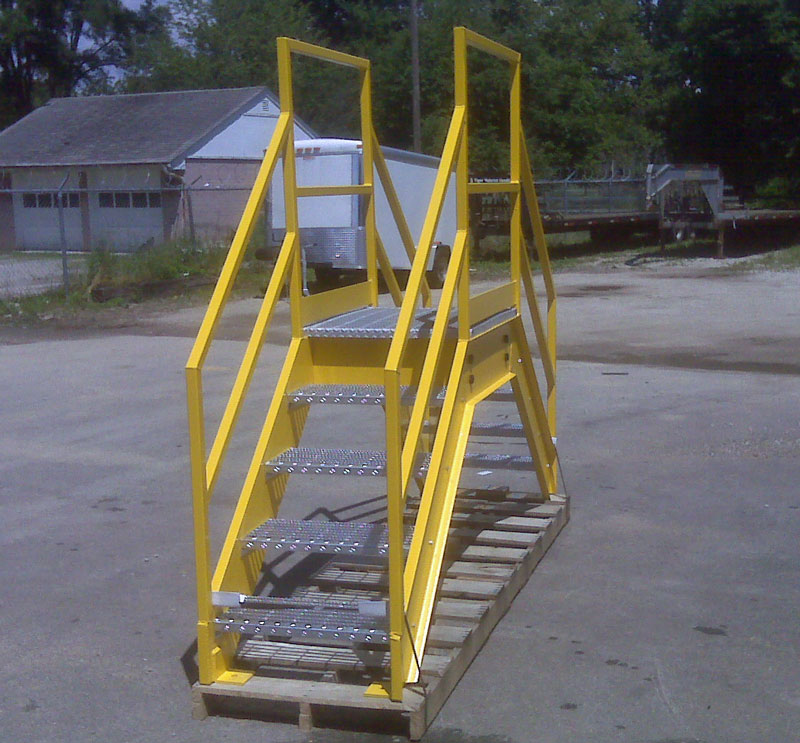
paint galvanized metal stair crossover

Stair crossover with yellow paint over galvanized steel handrails and stringers

What are some paints that are available for use over galvanized steel?

After the surface is clean and profiled you are ready to paint. A primer such as Sherwin Williams “pro-cryl” can be used. This primer dries fast and is corrosion resistant. You can top coat shortly after that with an acrylic coating paint like “DTM”. Check with your local paint supplier for additional options, as well as to get re-coat and cure times based on your temperature, humidity and paint thickness.
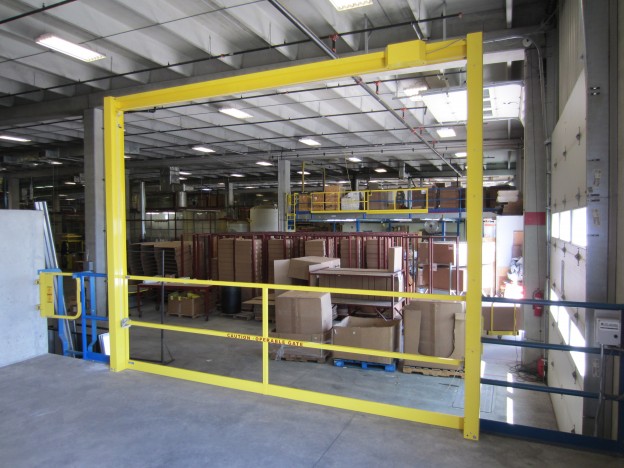
 

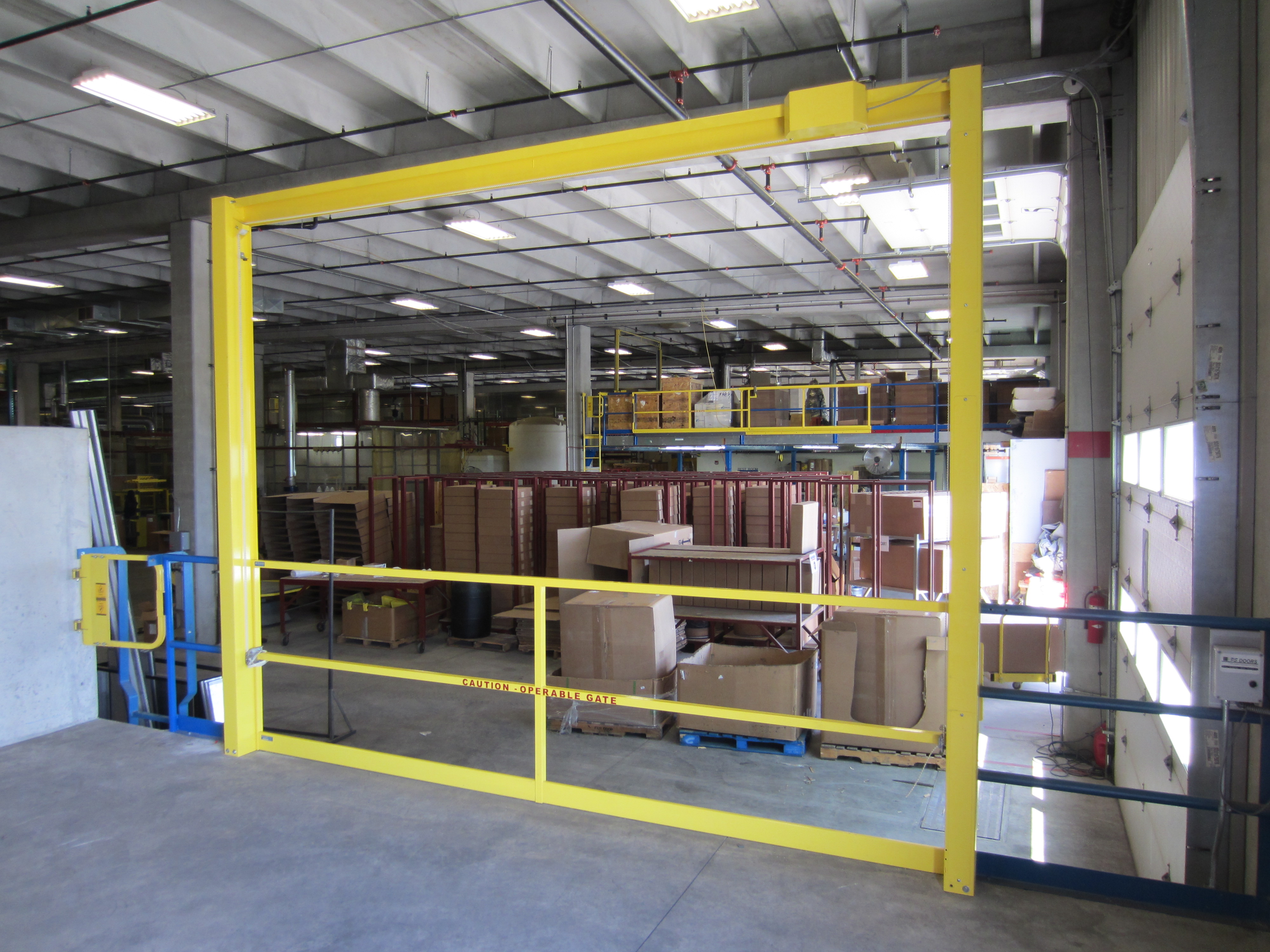
Vertical mezzanine gate in the down position

The Newly Redesigned Vertical Lifting Mezzanine Gate

Vertical mezzanine gate in raised position

Electric vertical lifting mezzanine gate in action

By Derick @ A-Mezz

Recently, the vertical lifting mezzanine gate received a redesign.  I’d like to take a moment to go over some of the modifications made to better assist our customers.

The most noticable change in the design was to how the gate moves along the columns.  In the old design the gate traveled to approximately 6” from the top of the column.  This would vary a bit depending on the size of the counterweight required.  We most commonly used a 12’ tall column which would allow for approximately an 8’ clearance height under the raised gate.   The gates operation has changed slightly.  We now typically use a 10’ tall column and the gate now travels beyond the columns by 6” allowing for a 7’ clear height under the raised gate.  As before, custom heights are still available, but by more efficiently utilizing our customers’ vertical space, the new vertical mezzanine gate is a great option in more locations.

Vertical mezzanine gate in the down position

Closed electric vertical lifting mezzanine gate

One of primary goals for the redesign was to improve the lead time.  In the old design, every mezzanine gate was a custom unit.  Each mezzanine gate would require its own set of drawings to be drafted, and would need to be made from scratch as the orders where approved.  In the redesigned gate, many of the components where standardized.  We are now able to provide our vertical mezzanine gate customers with their approval drawings typically in a day or two, and improved the overall production cycle as well to about 6 weeks on average.  To further improve our lead times, we took two of our most requested sizes and began stocking many of the components.  We can now typically ship out standard 6’ or 8’ clear width vertical mezzanine gates in powder coated mild steel in about 3 weeks on average.

Our vertical mezzanine gates have always been available in manual, electric, pneumatic with electric controls, or fully pneumatic for explosive environments.  From time to time we receive calls from customers who previously purchased a manual mezzanine gate and wanting to upgrade it to an automated unit.  Unfortunately with the old design there was no easy way to convert it, and the customers would need to replace the gate.  With the redesigned vertical mezzanine gate, a customer can purchase a manual gate, and in the future if they are looking to upgrade it purchase a kit to easily convert their existing gate in the field.  When the factory built their prototype, it only took them 15 minutes to convert a manual vertical mezzanine gate into an electric gate.

We’re really pleased with how the redesigned vertical mezzanine gate turned out.  The changes in the design have made a marked improvement in the lead times while not just maintaining its adaptability, but improving it.


Pedestrian Walkway Gate

pedestrian safety gate

MLG gate used as a pedestrian walkway gate

We were contacted by a customer in Texas who wanted to put up some safety gates to alert employees and visitors of their noisy location to the heavy vehicle traffic. They used our MLG ladder gates to accomplish this. The safety swing gates are installed so that the user must pull the gate towards them and then step through the opening. This way they cannot just cross the heavy machinery vehicle traffic without being alerted to the large trucks that constantly pass by.

Our powder coat yellow gate closely matches their existing handrail in both the color and rail dimensions. The gate swings one way, but it can be flipped on the horizontal and vertical axis to achieve a left hand swing, a right hand swing, and a swing in, or swing out.

In this instance the existing handrail was a 1-1/2” sq. tube so they were able to bolt the gate to their handrails using the supplied U-bolts. Installation took about five minutes per safety swing gate.

Why are gates needed in areas like this? Look at the below reminders for pedestrians when around fork lifts and heavy machinery traffic from OSHA’s website :

  • Be aware that lift trucks cannot stop suddenly. They are designed to stop slowly to minimize load damage and maintain stability.
  • Stand clear of lift trucks in operation.
  • Avoid a run-in. The driver’s visibility may be limited due to blind spots.
  • Be aware of the wide rear swing radius.
  • Use pedestrian walkways, or stay to one side of the equipment aisle.
  • Never pass under an elevated load.

OSHA suggests that plant managers separate pedestrians from lift trucks by providing pedestrian walkways with permanent railings or other protective barriers, adequate walking space at least on one side, if pedestrians must use equipment aisles or pedestrian walkway striping on the floor, and/or if barriers cannot be used.

OSHA requires that permanent aisles and passageways be free from obstructions and appropriately marked where mechanical handling equipment is used. [29 CFR 1910.176(a)]

For the above customer, our MLG ladder safety gates helped them meet OSHA standard 29 CFR 1910.176(a) in a cost effective and safe manner.


Galvanized Ladder Gates for Survey Tower Safety

By Brett @ A-Mezz

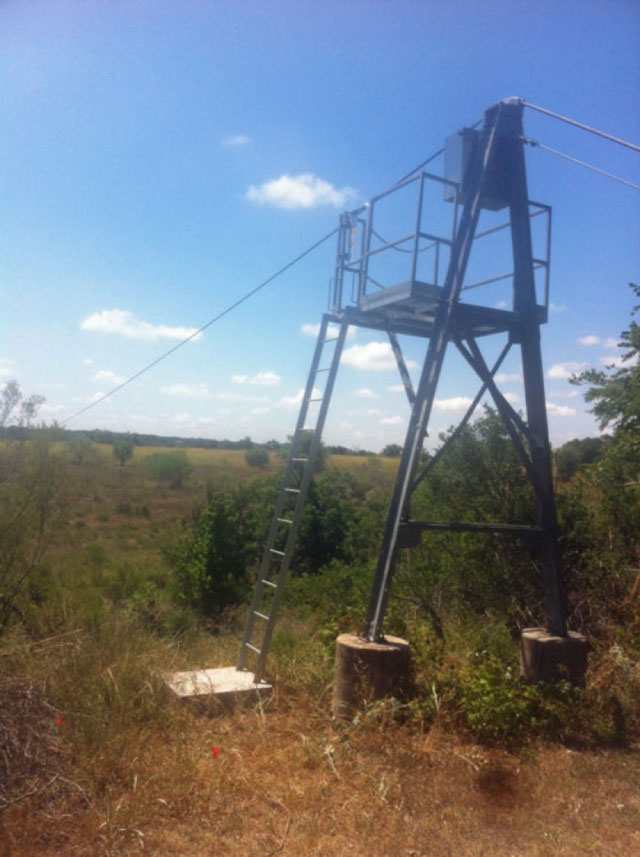
Protecting unguarded railing openings with ladder safety gates on a 12’h survey tower in Texas

Protecting unguarded railing openings with ladder safety gates on a 12’h survey tower in Texas

We received these photos back from a happy customer who contacted us looking for safe platform access by their ladder for a survey tower in San Antonio, Texas. They were accessing the tower shown by a fixed ladder but they did not have any fall protection at the ladder opening which is the OSHA requirement.

(OSHA 1910.23(a)(2):

Every ladderway floor opening or platform shall be guarded by a standard railing with standard toeboard on all exposed sides (except at entrance to opening), with the passage through the railing either provided with a swinging gate or so offset that a person cannot walk directly into the opening.

In other words you have to have a handrail with toeboard on all sides of an elevated structure, but at the ladder opening you have two options. Option #1 is to use a safety gate with top and mid rail but without the 4”high toe guard. This is your most common solution. Option #2 is to have the ladder offset so that you cannot step directly into the opening. This can add much cost to a job as you have to add landing space and railing to achieve the offset install location. As this survey tower was not using an offset landing for the ladder, the gate was this customer’s only option available to comply with OSHA standards.

After showing them several options, they finally decided on the MLG galvanized ladder gates. For something that was going to sit out in the elements and hopefully receive no maintenance, the galvanized gate with stainless steel springs was the best fit. The MLG gate also ended up being more than 20% cheaper than their other options so they saved some money on the project as well.

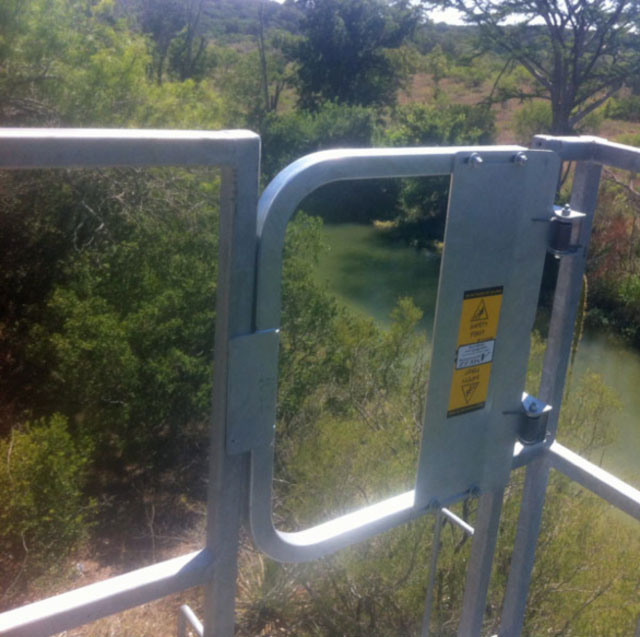
Close up of the galvanized ladder gate

Close up of the galvanized ladder gate

Here you can see a close-up of the ladder gate.  Installation was fast and simple:  flip the gate around to get to the proper orientation, bolt the supplied U bolts around the existing railing, and adjust the length of the gate arm.  Flipping the safety gate allows it to pull people away from the edge of the platform and into the middle.  Installation took about 5 minutes from the time they unboxed the gate to completion, and now when they climb up the ladder they only have to push the gate in with their bodies and step onto the platform.  No more reaching up to unhook chains – which don’t meet OSHA standards at ladder openings – or worrying about staying clear of an unguarded ladder opening.

This customer was so pleased with how our ladder gates worked for their unprotected opening that they called back and ordered more safety gates for another survey tower ladder of theirs.