Tag Archives: ladder

Steel Fixed Ladder Handrail Options

Does my ladder need a handrail?

Almost all ladders will have an extension at the top, with the only exceptions being ladders accessing roof hatches, manholes, floor doors, or anything else that closes over the top of the ladder. If you are exiting the ladder to the side or going to an offset platform due to the 30’ maximum climbing distance between ladders, you will need to add four more rungs above the platform. Those rungs are only to be used for hand-hold only, to give you something to grab onto to safely exit the ladder.
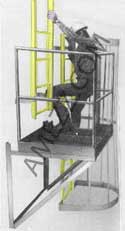
 

Side step ladder platform for climbs over 30' in length

Side step ladder platform for climbs over 30′ in length

If the ladder is going up to a wall, to a roof, or to a mezzanine, then you will need extensions on the ladder for the “walk-through” exit of the ladder.

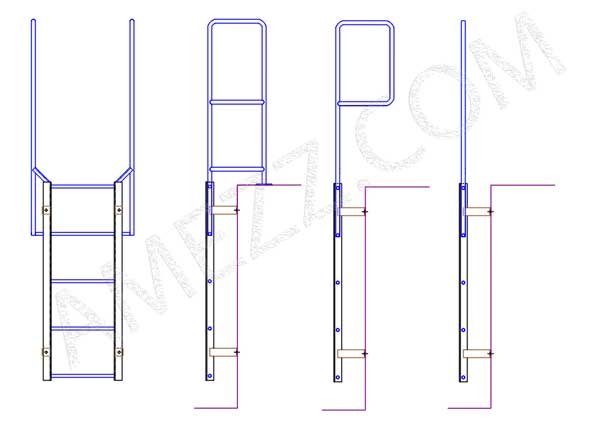
We have three different designs of walk-through handrails and I’ll go into the details on each of them below.
Steel ladder handrail options

Steel ladder handrail options

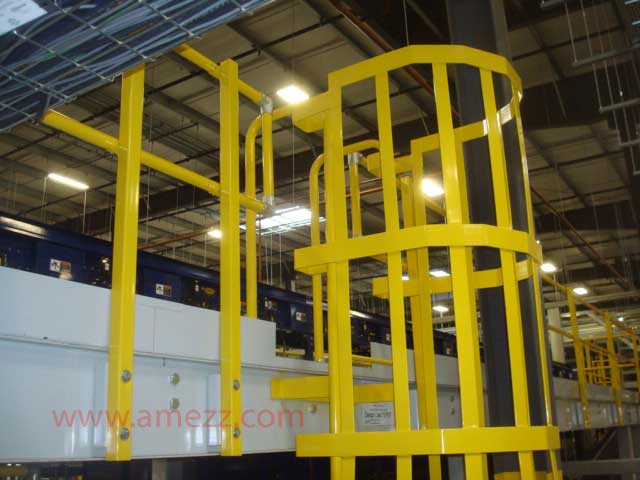
The first design, the “8” shape, is our standard ladder design. This is the most commonly used handrail setup as it allows for the top of the walk-through to mount to the landing surface, providing the greatest rigidity at the handrail. It also makes installation easy, as there are no questions where the top rung mounts; it is always installed properly meeting the top of the landing surface as required by code.

In cases of short parapets or locations where you cannot have the walk-through handrail anchor to or even set upon the roof you would use the second “P” profile, our “self supported walk-through handrail”. This handrail design works well when there is a parapet under 14” high that the handrail mounting pads would not line up with. It is not a necessity to use the “P” shaped handrail in those instances. Many installers still prefer the “8” layout for the added cross brace back to the ladder. When installing a ladder with our self-supported walk-through handrail, be sure to install properly, with the top rung level with the top of your roof. There is no foot pad at the top to ensure this is done, so installation just requires a check to be sure of compliance.

The last ladder handrail design is our “customer supplied walk-through handrail”. This is used in instances where the installation location has existing railing and handrails that they want to weld the walk-through handrail to. This is useful in locations where space is minimal and existing site conditions allow for field welding to existing rails.

Not shown is our step across platform, which is essentially a crossover used when site conditions require the ladder rung to be more than 12” away from the landing surface as required by OSHA standards. Most commonly, this is used on locations with gutters that are more than 5” off the face of the climbing side of the wall.

OSHA 1910.27(d)(3)

“Ladder extensions.” The side rails of through or side-step ladder extensions shall extend 3 1/2 feet above parapets and landings. For through ladder extensions, the rungs shall be omitted from the extension and shall have not less than 18 nor more than 24 inches clearance between rails. For side-step or offset fixed ladder sections, at landings, the side rails and rungs shall be carried to the next regular rung beyond or above the 3 1/2 feet minimum (fig. D-10).
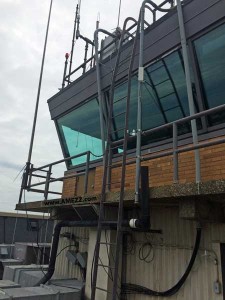
Ladder Modification to Meet OSHA standards

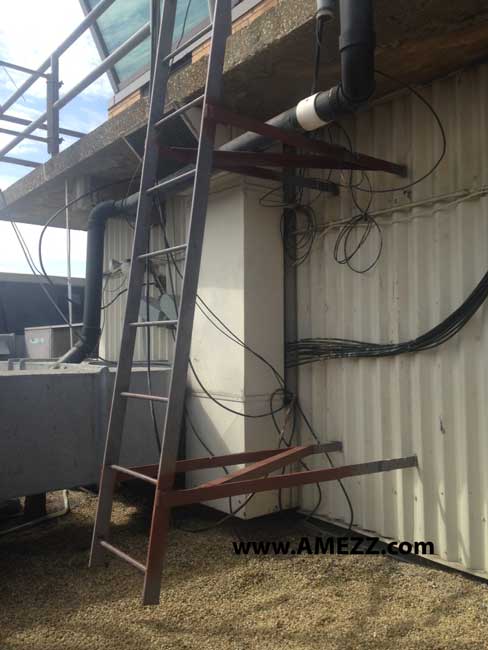
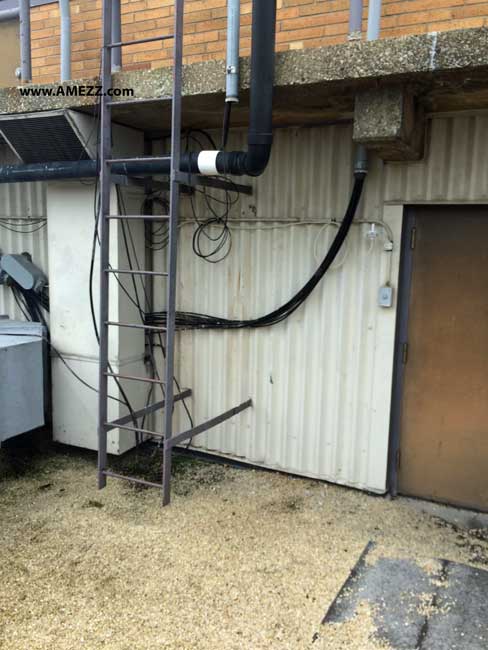
control_tower_ladderWe recently were called out to look at a ladder that did not meet OSHA standards (1910.27) for clearance on the back side of the ladder. The ladder also had two angles of climb as shown in the above photo. When climbing up the ladder, the concrete walk was too close to the ladder for you to safely grasp the rung and also to put your foot on the rung while climbing. The ladder was accessing the top of the traffic control tower at an airport, and as such, we had to work around a variety of factors to ensure a proper replacement or modification of the ladder could take place without interrupting operations. As the install location was at an airport, the use of a crane to bring a replacement ladder to location would have been a logistical nightmare. We decided that whatever the solution was, it was to be brought up from the inside of the tower.
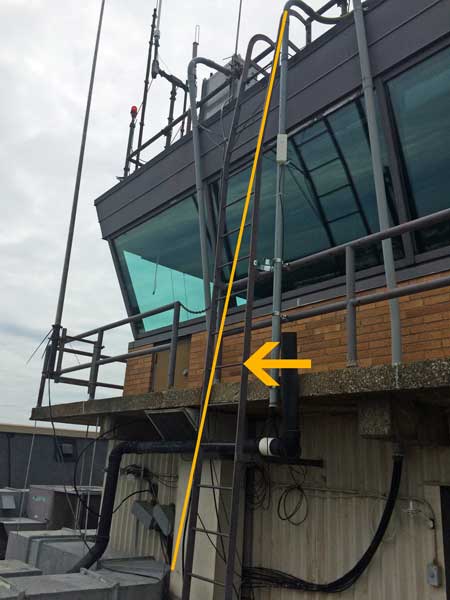
control_tower_ladder_option1Our first option was to remove the ladder and replace it with a 90 degree ladder. That is the most common fixed ladder type. There were, however, issues with supplying a replacement ladder.  First off, the concrete walk and rail were extended beyond the top of the tower. This meant that our replacement ladder would need to be very far from the structure in order to give us the required 7” clearance behind the ladder at the concrete walk location. That is not a deal breaker, but holding so far off the structure would have also required an extra-long crossover to reach the tower roof.  OSHA allows the ladder to have a maximum 12” step across at the top of the ladder. As the ladder has to stand 7” off of the wall (or the furthest obstruction off the wall) you can get by without a step across platform if the obstruction is 5” or under (5+7=12). The replacement ladder would have been very large. Ordinarily, this too can be dealt with by using our modular line. Our Modular Fixed Ladders come in pieces no larger than 7’L. Each ladder section bolts to the next one and has a pair of standoff brackets before and after the splice.

We could not accommodate additional standoff brackets required by the modular design so we would have needed to weld each splice together. Again, this was not a deal breaker either, but it did make this option less economical than other options.

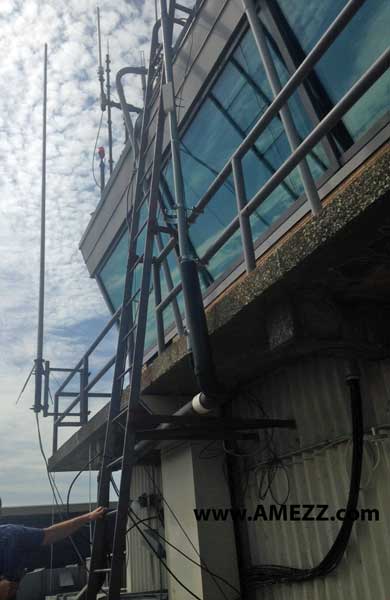
control_tower_ladder_option2We decided that it was more economical to modify the existing ladder. The top of the ladder was already angled at an 81 degree angle. In the field we ran a laser down the ladder from the top to see where we would land if we kept that same angle throughout the climbing run. By cutting the ladder at the bend, and then cutting each of the lower standoff brackets, we were able to gain close to a foot of clearance at the concrete landing, well within the acceptable tolerances of OSHA’s standards. This option was not without its challenges though. As the ladder was going to be sticking off the wall even further than before, we were concerned about having a stable climb.

Here is the original ladder with the standoff brackets back to the structure.

Here is the original ladder with the standoff brackets back to the structure.

control_tower_ladder_afterWe added cross bracing across the two standoff brackets to stiffen the ladder up with the extended bracket length. After modifying the ladder, the bottom rung was still within the 14” allowed by ANSI A14.3, so no additional ladder rungs were required. Each welded location was then sanded down to remove any sharp edges or burrs and painted with a rust inhibiting primer. The end user was going to have their maintenance department repaint the ladder after completion of the work to help cut down on costs.

The ladder modification was completed at budget and within the scheduled time. Most importantly, the customer now had safe access to their roof. If you have a unique situation like this, give us a call. We can help you come up with the solution that fits your site requirements and budget, too.

completed_control_tower_ladder

Do I Need a Swing Gate on My Fixed Ladder?


Walk-thru fixed ladder with cage

Walk-thru fixed ladder with safety cage

Do you need a ladder gate at your ladder opening in your railing? According to OSHA 1910.28(b)(3)(iv)“Each employee is protected from falling into a ladderway floor hole or ladderway platform hole by a guardrail system and toeboards erected on all exposed sides, except at the entrance to the hole, where a self-closing gate or an offset must be used.”

This means that every ladder opening needs to be either (a) Offset so that a person cannot walk (or fall) directly into the opening or (b) Protected by a ladder safety gate. It is an easy either/or. The most common ladder installation locations are not offset and as such require safety gates. Below you will see some photos of ladders and top view sketches clarifying why each of their orientations either do or do not require a gate. Note: ladder chains do not meet OSHA standards.

Another seemingly redundant standard from OSHA further increases the areas requiring gates is 1910.29(b)(13) and 1910.29(b)(13)(i): When guardrail systems are used around holes that serve as points of access (such as ladderways), the guardrail system opening: (1910.29(b)(13)(i) has a self closing gate that slides or swings away from the hole, and is equipped with a top rail and midrail or equivalent intermediate member(…). 

This standard opens up gate requirements to manhole covers, roof hatches and other similar systems that would remain open while accessed.

Now that we know what the code requirement is, it is time to review a few common ladder mounting orientations to discuss where they fall under the code.

Fixed ladder mounted to side of platform

Fixed ladder mounted to side of platform

The above fixed ladder is mounted onto the side of the platform. Work is performed further down the platform but it is possible to fall directly down the ladder opening. This location is not offset and as such would require a swing gate. See the below top view sketch for clarification.

Top view sketch of side mounted fixed ladderway opening

Top view sketch of side mounted fixed ladderway opening

You can walk directly to the ladder opening from where work is/can be expected to be performed and as such, a safety gate is required at the ladder opening.

Fixed ladder with offset landing platform

Fixed ladder with offset landing platform

The above ladder accesses a platform and then turns to access the main walkway. This ladder is offset and would not require a swing gate at the opening.

Top view sketch of offset mounted fixed ladderway opening

Top view sketch of offset mounted fixed ladderway opening

As you can see above, if someone fell while at the main walkway they would fall onto the ladder landing surface, they would not fall down the ladder opening. If the ladder was rotated to the left side of the landing it would require a safety gate because then the ladder opening would no longer be offset.

Ladderway opening on side of catwalk

Ladderway opening on side of catwalk

Above is a very common ladder mount position. This one can be tricky until you lay it out from the top view. From first glance it looks like because the ladder is off to the side that it would be offset from the normal flow of traffic, but if you fell at that point of the catwalk there would be no guarding to protect you. A swing gate is a requirement at this location.

Top view sketch of catwalk side mounted fixed ladderway opening

Top view sketch of catwalk side mounted fixed ladderway opening

As you can see from the above sketch, there is a single direction of travel to the ladder from the catwalk. This is not offset. It would be a single direction fall into the ladder opening and as such, a ladder safety gate is required to protect your employees when a ladder is installed in the above orientation.

Most areas are not offset. A good rule of thumb is that if you can fall into the ladder opening with a single direction fall, then you are not offset. The only example above that didn’t need a gate was the second ladder location. With that orientation, you would fall onto the ladder landing and then hit the rear railing, not fall through the ladder opening.

Stay safe everyone!

We received a sobering message from a customer looking at our caged fixed ladders today:

 “My dad fell off of the roof to his death in June while trying to come down the ladder he had rested on the side of the building.  I believe his foot got caught in the rope.  If he had had one of these ladders this would not have happened.”

Stay safe out there everyone. I know that the above was just a random accident but if there is the chance that you can prevent those, especially after hearing about what can happen, why wouldn’t you?  Taking precautions and doing things the safe and right way may take a little longer or cost a little more, but going home to our loved ones at the end of the day is worth any price.

Our sincere condolences are with this customer and their family and hopefully sharing this story will cause someone else to take a moment to look around and make sure they are taking all necessary safety precautions. If you are unsure if you are doing something right, ask someone.

With a little help we can all make it home safe tonight.

Catwalk Access Ladder

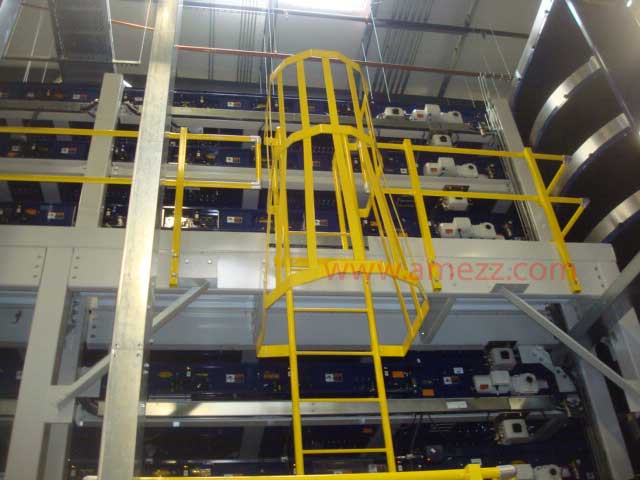
fixed access ladder for catwalk use

Uncaged Ladder for Catwalk Access

We supplied the above permanent ladder to a customer who was accessing elevated sections of their presses with catwalk platforms. As the top landings for the presses were infrequently accessed, and floor space was minimal, using a fixed ladder with a walk through handrail was the best solution due to its small footprint, safe access and low cost.

Our standard fixed 8 rung ladders have two pairs of standoff brackets to mount to the wall, but because there was no wall to mount the ladder to in this instance, the installer fabricated custom plates for the wall mount brackets to bolt to. Those custom brackets then mounted to the single C-channel running behind the access ladder.

The ladder was supplied with a walk through handrail that they bolted to the top of their landing. Even though they have OSHA handrail on the catwalk the ladder needed its own walk through rails per OSHA 1910.27(d)(3) which states:

 “The side rails of through or side-step ladder extensions shall extend 3 1/2 feet above parapets and landings. For through ladder extensions, the rungs shall be omitted from the extension and shall have not less than 18 nor more than 24 inches clearance between rails.”

There are two main instances that you would find a ladder without the walk through handrails. The first is when you are stepping off to the side of the access ladder to exit (right or left hand exit). Keep in mind that when doing a side exit off your permanently fixed ladder you will still need to have four additional ladder rungs above the landing surface to meet the 42” extension, you wouldn’t just omit the rungs from the extension. Those additional ladder rungs would be for hand hold only.

The second instance that you would not need a walk through handrail is when the fixed ladder is accessing a manhole or any climbs that terminate with hatches. There is no walk through handrail requirement in OSHA 1910.27 for manholes or hatches, and as such, grab bar devices would be voluntary.  For information on OSHA’s thoughts regarding telescoping ladder posts see the following letter: http://www.ladderhatch.com/osha-roof-hatch-interpretation.htm