Metal Stairs & Staircases for Industrial Applications
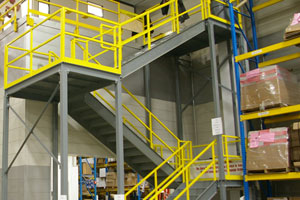
Our steel stairs are ideal for various industrial applications including mezzanines, conveyor crossovers, construction job site trailers, stair towers, loading dock access, racking or shelving systems, in-plant offices, fire exits and more. These durable stairs offer:
- Easy to assemble construction
- Simple nut and bolt connections
- Strength and stability
- Flexibility for custom applications
The A-Mezz stairs are designed to meet the building codes of your state. IBC code, which is in use in every state, meets and exceed federal OSHA standards. This means that following IBC code, you will meet or exceed the OSHA standards, but by following the OSHA standards, you will NOT meet your state stair code. If your stairs are accessing an equipment platform or confined space we can design the stairs to meet the appropriate code requirements which often times fall under the OSHA standards and not IBC. Ultimately though, the final determination comes down to your local municipalities interpretation of the usage and code.
We've supplied steel stair systems all across the nation and have worked with many different requirements. If PE stamped drawings and/or calculations are required for your stair job they are available at an additional cost.
Custom applications are no problem for our metal stair systems. We can work around space limitations, obstructions like doorways, electrical panels, equipment and more with a custom configuration and specially sized stair landings to achieve the access needed in the space available.
Steel Stair Treads:
For our metal stair products required to meet state building codes the most common sizes for tread widths are 36" (for locations with an occupied load of less than 50 people), 44" (required in areas with an occupied load of 50 or more people), and 48" as requested. We can also accommodate different stair widths as required. OSHA standards allow you to go as low as 24" wide for stair tread width but any width 24" and greater, as long as it complies with the building codes, can be supplied.
Our steel stairs can come with stair treads and landings made of closed diamond plate, bar grating, serrated bar grating, grip strut and also with pans for you to pour concrete in. As stated earlier, if your steel stair requirements dictate a tread not listed we can most likely accommodate that request. Just give us a call or fill out the request to the right and we will contact you to get the specifics.
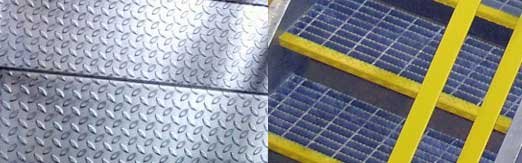
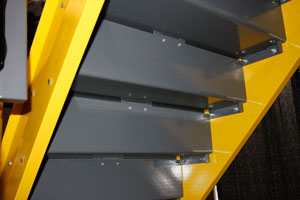
Example of stainless steel diamond plate treads and galvanized bar grating treads with custom painted nosing
Steel Stair Finishes:
For exterior locations, the most commonly used finish is hot dipped galvanized. This metal finish is the most durable and requires the least amount of upkeep for your stair.
For interior applications our most commonly requested finish is a single coat of flat shop gray or white primer. We can paint steel stairs with an industrial enamel finish. Keep in mind that by the time metal stairs are shipped, offloaded from the truck, moved into location and assembled, all painted products will most likely need some touch-up paint as the last step in the assembly process. It is for this reason that the primer finish is our most common interior steel stair finish.
If your stair needs require a different finish don't worry. We have done custom finishes like paint over galvanization, powder coating, and epoxy paint on our metal stair products as well. Just let us know the details and we will be glad to help.
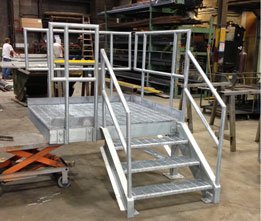
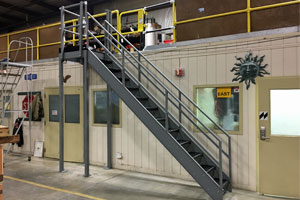
Galvanized construction trailer staircase
Steel Stair Handrails:
We can furnish our steel stairs with the proper handrail to meet your building code.
Our steel OSHA stairs accessing some equipment platforms or confined space applications can have a standard OSHA compliant two rail handrail with a top and mid rail.
For other industrial applications required to meet IBC code, we have a two rail handrail with an additional grab bar. These handrails also have extensions at the top and bottom beyond the stair run as required by code.
If your stair application requires public access stair rails that do not allow a 4" sphere to pass through its openings, we can provide steel stairs with 4" on center horizontal rails.
Lastly, at locations where stairs will be installed directly against a wall, you can utilize a wall mounted handrail designed to bolt onto the wall instead of being attached to the stair. This is important because using a standard handrail in these locations often means that there is not enough room to grab onto the handrail because it is mounted up against the wall. The wall mounted stair rail gives people enough room to properly grasp the handrail with these installation locations.
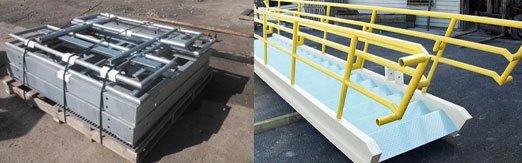
Stairs ship knocked down for freight savings or fully assembled for fast drop in place installation.
Things to consider:
- Whenever possible, always try to keep the location the stair is accessing to 12'h or shorter. All stairs greater than 12'h require an intermediate landing per code.
- Stairs are required to be at least 44" wide per IBC, however, there is an exception in the code that allows stair width to drop to 36" for stairs serving an occupied load of less than 50 people. This can save you money and valuable floor space.
- IBC stair code requires stairs to have closed treads only if they are areas of parking structures accessible to the public, as long as a sphere with a diameter of 1 1/8 inches (29 mm) cannot pass through the opening. What this means is that you can use bar grating treads in many exterior locations to allow for self clearing of snow and dirt. If there is a chance of your stairs seeing high heals or kid fingers, please use closed treads for safety.
- The most economical tread material option is closed diamond plate.
- All hardware for stair installation comes with the staircase kit except for floor anchors. They are dependent upon site conditions.
- Ensure that you have no obstructions where you want your stair run to go. This includes electrical panels, doorways and floor drains that may interfere with stair support placement or stringer run.
- If your floor is not level you will need to verify the height at the start of the stairs and the height at the end of the stairs so that we can supply longer (or shorter) supports as needed.
Most of our stair units can be installed by two people in one day.
When planning your stair, make sure you have enough floor space for the stairs. If not, we can often break the stairs into an "L" shape or "U" shape if a straight run will not fit. If you are not sure if you have the space, we can easily let you know what floor space your stair height will require.
Depending upon your needs we can supply bolt on handrail or handrail pre-welded to the stringer, a solid stringer or a split stringer with bolt together connections, single direction safety gates at top of stairs for fall protection and more. Please fill out the form to the right or call for a quote.
OSHA, BOCA, UBC & IBC Regulations & Codes:
OSHA Industrial Stairs Std. 1910.24
IBC: International Building Code
*BOCA: Building Officials and Code Administrators
*UBC: Uniform Building Code
Note: In 2000 the UBC code was replaced by the ICC (international code council) and the resulting code IBC was formed. In 2002 BOCA, SBCCI and ICBO merged and were replaced by IBC.